Speak Easy Circus: Notes from a band’s first rural tour
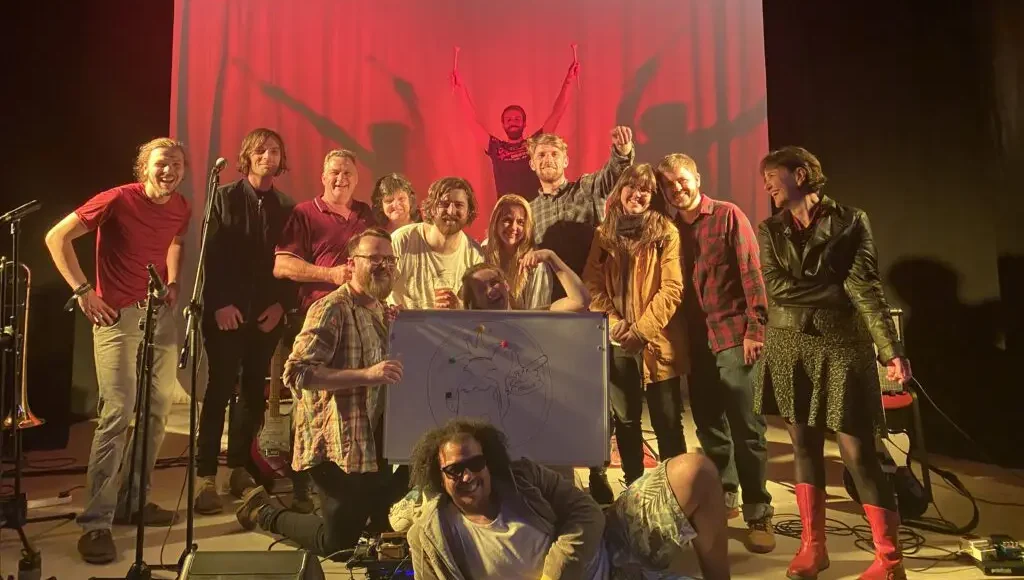
Performers Speak Easy Circus embarked on a tour around the Highlands in Spring 2022. Our advice and guidance are no substitute for lived experience and we hope their sharing can be of real use to other performers who are new to rural touring, and to venues/promoters, opening up discussion around needs, responsibilities, communication and expectations on all sides.
This blog was published in late 2022.
The band were supported to document the tour through our Seed Fund.
Introduction
We are Speak Easy Circus, an indie/funk band based in Glasgow. We originally started as a solo project recording in my (Jack) bedroom in 2019, before bringing aboard the rest of the band to play live shows.
We really wanted to go on a tour when Covid restrictions lifted, and we wanted to go around parts of Scotland we had never been before – to set ourselves a challenge and to have a bit of an adventure.
We wanted to write this case study to discuss our experiences touring around the north of Scotland, and hopefully provide some advice or help for other artists that may be considering doing the same. We had an amazing experience, filled with ups and downs, but rural touring is challenging and I don’t believe it’s accessible for a lot of acts.
Getting Ready
January 2022 was when I first had the idea of doing a tour around the Highlands. We had obviously spent a long time in lockdown and had been unable to play shows. When shows were viable again, we found ourselves competing against every other band in the world, or so it appeared to us. We decided we would try to create our own shows, and go places that wouldn’t typically be on a tour route for Glasgow bands. We wanted to explore this part of Scotland and set ourselves the challenge of going to remote areas and playing successful shows.
I wasn’t familiar with the area before planning the tour, but I was rather optimistic, as I felt that if we put on shows then we would be able to get people to come along.
We decided that we wanted to partner with a charity for the tour, with all proceeds going towards Barnardo’s Children’s Charity. They have an office based in Inverness and our saxophone player Jon is familiar with the charity as his family have been involved in fostering kids for around 20 years.
I began organising the tour in February, firstly by making a loose plan as to where we would go, and contacting as many venues as we could to try to find any that may be suitable. At this stage, we also had some support from Staged. Live!, who offered support and put us in contact with some venues. The response from venues was mixed. We ended up playing 10 shows, but we must have spoken to close to 100 venues. Some told us outright that it wasn’t suitable and some took details and didn’t get back to us.
Communication was patchy. There was sometimes a sense of confusion as if promoters didn’t understand why we wanted to play in their community. We found ourselves having to really sell the band and convince people that it would be a good idea. We were looking to hire the venues for a fee but there was often a sense that venues didn’t want to take on anything that could be considered a risk. There were of course exceptions to this. Some people were so enthusiastic and motivated – these were the shows that were inevitably the most successful.
Around this time, I started to use Tourbook to find venues. For locating hosts, it worked extremely well. However, I sent around 25 messages to venues and only received one reply. We received a message from a hall confused as to why we’d announced a show there as they were unaware of the booking, which had gone through an external promoter. Mandy Hampton at Craignish Hall also found us on Tourbook. She was enthusiastic and highly motivated from the start and this gig was a definite highlight of the tour.
Some of the main challenges of the tour were things we were not able to resolve and had to work around. Other acts might not have the same flexibility or backup options.
Transport
We were looking to rent a van to transport all of us and our equipment. The cheapest van that we could find to rent would work out around £1,500 for two weeks, effectively destroying our budget before we had even begun. We tried to reach out to arrange some sponsorship but had no such luck. As a result, we ended up going in two cars – our drummer’s car with three people, and our trombone player’s parent’s car. We put the back seats down and turned this car into a de facto ‘van’. However, not everyone will have this available to them and transport could be a big obstacle.
Accommodation
The accommodation was also a difficulty. Everything in the Highlands was very expensive if it was available at all. We ended up camping for half of the nights to keep things cost-effective. We were also able to take advantage of the fact that Jon’s family live close to Inverness, and for the second week of the tour, we used their house as a base to go to and from gigs. This saved us a lot of money and meant we didn’t have to camp. Again, this is not something that would be available to everyone and accommodation could be a big obstacle.
Equipment
Some of the venues we were going to did not have equipment such as PA etc. We knew this going in and were preparing for it, but this is still an obstacle. We ended up investing ourselves in a large amount of equipment, including a PA system with speakers, a power amp, a mixing desk, multiple mics, stands etc. to go along with our instruments and amps. This is not something that everyone would be able to do.
Tickets
Probably the biggest issue, and the one that would affect the tour the most, was ticket sales. We found this extremely challenging as we had not been to the majority of places, never mind played there, and no one knew who we were. We did our best to do online advertising and contact news outlets to try to get some interest. I sent every venue a pack of posters and flyers, some of which were put up, some of which were not. My Dad even drove the route the week before to leave posters and flyers around. However, the reality is that for any given gig we had only managed to sell a few tickets online beforehand. This led to us changing our tactics and moving to a ‘pay what you feel’ donation instead.
We knew that the tour would be a gamble, and it was something that we were willing to take on. We set up a crowd funder to raise money for Barnardo’s before we set off, as we were very concerned that we would end up losing money and have nothing to give the charity. That idea worked very well and it meant we raised about £1,000 beforehand and it took some pressure off us financially. In the end, I put £1,000 of my money into the tour and we all agreed to pay our expenses, break-even and donate all remaining profits to Barnardo’s. This was a big risk and I had to accept that it was possible I would lose that money. While it worked out in our case, it is asking a lot of bands to take such a financial risk. We were still extremely excited about the tour and we couldn’t wait to get started.
On the road
Our experience on the road was hugely dependent on the people involved; the promoters/venues as well as the audiences. We had great experiences in places such as Skye Bridge Studios in Kyle of Lochalsh, Gairloch Community Hall and Durness Village Hall. Even though the turn-out was relatively small, up to approx. 50 people a night. In these venues, audiences got into the show and there was a feeling that people in the village were enthusiastic about us playing there. We had everyone up and dancing and it was overall a very feel-good show.
We also had some less positive experiences, where we sold very few tickets, with single-digit audiences. These were the venues with which we’d had the least input or communication from promoters on the ground. We arrived at some places where staff didn’t know we were playing, never mind people in the area. This was frustrating as we were limited in what we could do with promotion at the final hour in an area we had never been to. The first time this happened we continued with the show as normal, fully electric etc. But we learned this was a mistake – it resulted in a very awkward and uncomfortable show for us and the audience. We had another two similar shows and we pivoted to an acoustic set, a sort of ‘live lounge’ feel, in which we set up chairs in a semi-circle and did a much more relaxed, informal acoustic show, with more chatting etc. and this was much better for us and the audience as well.
Our last two shows were at Hootenanny’s in Inverness and Craignish Village Hall, and they were the biggest shows on the tour. Inverness was the first city we had been to so it made sense that more people would come along to that one, and the success of Craignish was largely down to the work of Mandy, who put in a huge amount of effort to fill up the hall. Mandy dealt with the promotion, flyers, tickets, bar, sound engineers – actually pretty much every element of the show, which made a huge difference to us.
A big challenge on this tour was the fact that we were doing everything ourselves for the vast majority. This meant we were doing all the driving, arriving and setting up our tents, then flyering and running around the village trying to drum up some interest in the show, then going to the venue and setting everything up (full PA etc), sound check, more flyering, playing the show, taking everything down, then driving to the campsite and going to sleep, before getting up the next morning and doing the whole thing again. I ended up booking the first eight shows all in a row, which is something I have learned you shouldn’t do, especially if you are going to be doing everything yourselves. As you can imagine by the time of that 8th show we were all pretty exhausted and ready for a break. It was fairly easy to motivate ourselves if the show went well the night before, but extremely challenging if we had had a disappointing show. The shows that went well were amazing, with such positive energy and such a good night for everyone, and the shows that went poorly were very tough.
Back Home
After the tour finished we were all exhausted, but satisfied and incredibly proud of what we had managed to achieve. It helped that the last two shows had left us on a high. We played to around 500 people, as an estimate, and were able to raise money for Barnardo’s. We didn’t lose money and we were also able to do a music workshop with kids in Inverness in care. This was more than we had hoped for and meant the tour had been a massive success despite the ups and downs.
We were slightly surprised by the venues and villages that didn’t seem happy about events happening there. We went into it thinking that it could work because bands from Glasgow don’t often go to places that are further away, but some places weren’t as welcoming as we’d hoped.
Financially, we managed to raise a total of £1,963 for Barnardo’s, I was able to make back the £1,000 I had put in at the start, and each band member got around £150 back for expenses. Again, we considered this to be a success as we went into it thinking we would lose a lot of money.
Conclusion
We are very proud of our achievement, and consider the tour to have been a success. We had an unbelievable experience in some of the most beautiful parts of the world, we met some fantastic people and played some great acts, and we managed to play some great shows in front of amazing crowds.
However, the reality is that I do not see touring rural Scotland as a viable option for a band like us, without funding, support and active promoters on the ground.
It was lovely to raise money for Barnardo’s but the ‘charity’ side of things was the only thing that got our foot in the door of lots of places, and the only reason that lots of people ended up coming to some of the shows. If you were a band going on a for-profit tour in these areas I don’t think it would be possible. You would need to be willing to take a massive risk and be willing to lose money.
We will tour again – we’d like to go south too – but we would have to give it some serious consideration.